
 EN
EN
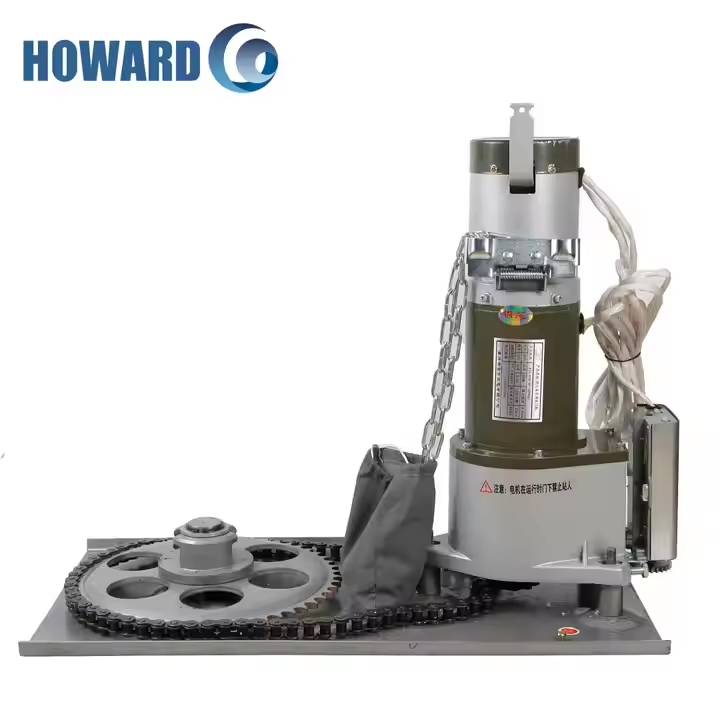
Match Rolling Door Motor Power and Torque to Operational Demands
Calculate torque requirements based on door mass, lift speed, and acceleration profile
Accurate torque calculation prevents premature motor failure and ensures smooth, reliable operation. Begin by determining the door’s total mass—insulated steel doors (1,500–2,500 lbs) demand significantly more torque than lighter fiberglass alternatives. Lift speed (typically 6–12 inches per second) and acceleration profile must also be factored in to avoid inertia-induced stress on gears and drive components. Industry data indicates that inadequate torque matching accounts for 63% of motor failures in industrial settings (2023). Use this baseline formula:
Torque (Nm) = (Door Mass × Gravity × Radius) / Gear Ratio,
where radius refers to the drum’s winding diameter. Motors delivering less than 1,200 Nm often fail prematurely under standard 3,000 lb loads, risking gearbox damage within early operational cycles.
Evaluate duty cycle: selecting a rolling door motor rated for 10–50+ cycles/hour in loading dock environments
High-frequency operations require motors engineered for continuous-duty performance. Loading docks averaging 30 cycles/hour need units rated for ≥100,000 cycles and equipped with robust thermal overload protection. Undersized motors contribute to 73% of bearing failures within 18 months in such environments. Key distinctions between application classes include:
| Feature | Residential Use | Industrial Use |
|---|---|---|
| Cycle Capacity | ≤10,000 cycles | 100,000+ cycles |
| Duty Rating | Intermittent (S3) | Continuous (S1) |
| Thermal Protection | Basic cutoff | Class F insulation (155°C) |
Continuous-duty motors reduce repair costs by 62% in facilities operating 18 hours daily. Always validate that the motor’s rated cycles/hour align with your facility’s peak demand—overlooking this mismatch causes 40% of premature replacements in distribution centers.
Verify Durability with Industry-Validated Cycle Life and Standards Compliance
Interpret ANSI/DASMA 109 Class IV ratings — the benchmark for industrial rolling door motor longevity
ANSI/DASMA 109 is the definitive U.S. standard for rolling door motor durability, with Class IV representing the highest endurance tier. A Class IV rating certifies the motor has been validated for 100,000 or more full open/close cycles under normal load conditions—making it essential for high-traffic industrial environments like loading docks, distribution centers, and manufacturing plants. This classification reflects not just theoretical design but real-world resilience under sustained mechanical and thermal stress.
Understand how 100,000+ cycle accelerated life testing translates to real-world reliability
Manufacturers validate Class IV compliance through accelerated life testing—repeating open/close cycles under full load, extreme temperatures, and mechanical strain to simulate years of service in weeks. A motor completing 100,000 consecutive cycles demonstrates proven reliability in its gear train, limit switches, bearings, and control electronics. This level of validation directly correlates with extended service life, reduced unplanned downtime, and lower lifetime maintenance costs. Always confirm third-party verification of Class IV cycle compliance is explicitly stated in the manufacturer’s datasheet—not assumed from marketing claims.
Prioritize Safety-Certified Rolling Door Motor Systems for Industrial Compliance
UL 325 certification essentials: why it’s non-negotiable for North American industrial rolling door motor installations
UL 325 is the mandatory safety standard for all rolling door motors installed in North American industrial facilities. It mandates rigorous third-party testing for entrapment prevention (e.g., photo-eye integration, force-limited auto-reverse), thermal overload response, electrical isolation, and emergency stop functionality. Non-compliant systems risk OSHA and NFPA inspection failures, operational shutdowns, and liability exposure from personnel or inventory incidents. UL 325–certified motors are engineered with fail-safe logic and redundant safeguards—making compliance foundational to both regulatory adherence and long-term operational trust.
Leverage Variable Frequency Drive (VFD) Technology for Motor Efficiency and Longevity
How VFD-integrated rolling door motors reduce thermal stress and extend service life by up to 40%
VFD-integrated motors deliver precise, adaptive control over speed and torque—eliminating the mechanical and thermal shock of fixed-speed startups. By ramping acceleration gradually, they reduce winding temperatures by 15–20°C during frequent cycling, slowing insulation degradation and bearing wear. This thermal management extends service intervals by 30–50% and cuts energy use during partial-load operation. Independent studies—including those from the U.S. Department of Energy—confirm VFD-enhanced motors achieve up to 40% longer lifespans in high-cycle industrial applications, with consistent 20–30% gains across comparable use cases. The result is measurable reductions in maintenance cost, downtime, and total cost of ownership.
Frequently Asked Questions (FAQ)
Why is torque matching important for rolling door motors?
Torque matching ensures that the motor can handle the door’s weight, lift speed, and acceleration profile, reducing the risk of premature motor failure and providing reliable operation.
What distinguishes industrial rolling door motors from residential ones?
Industrial motors are designed for continuous-duty applications and high-frequency use (≥100,000 cycles), while residential motors typically handle ≤10,000 cycles and feature intermittent duty ratings.
What does ANSI/DASMA 109 Class IV certification signify?
This certification guarantees that motors have been tested for 100,000 or more open/close cycles under normal load conditions, ensuring durability and reliability for industrial use.
Why is UL 325 certification critical?
UL 325 certification ensures compliance with North American safety standards, addressing entrapment prevention, thermal overload, and emergency stop functionalities to protect personnel and equipment.
How does VFD technology enhance rolling door motor efficiency?
VFD technology reduces thermal stress, extends service life by up to 40%, and minimizes energy consumption through adaptive speed and torque control during frequent cycling.
Table of Contents
- Match Rolling Door Motor Power and Torque to Operational Demands
- Verify Durability with Industry-Validated Cycle Life and Standards Compliance
- Prioritize Safety-Certified Rolling Door Motor Systems for Industrial Compliance
- Leverage Variable Frequency Drive (VFD) Technology for Motor Efficiency and Longevity
- Frequently Asked Questions (FAQ)